Автор: Мира Ларина · Модель: nano-banana-2-1k · Опубликовано 24.11.2026 · 1 лайк
только начинаю свой путь в искусство AI. Больше работ в инсте, вот ссылка https://www.instagram.com/damira_ai.creator?igsh=YzhuNTNzdmUzenY5 буду рада новым подписчикам, от себя гарантирую в ответ подписку.
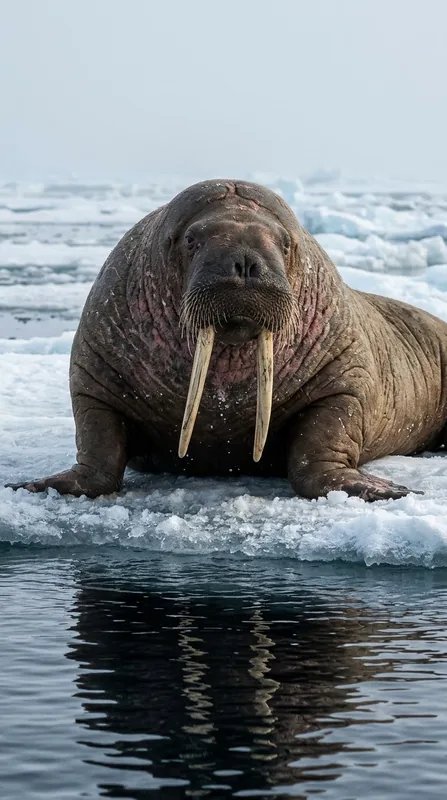
An extraordinary photorealistic Arctic wildlife editorial photograph for a prestigious National Geographic-style magazine cover. **CONCEPT — THE LAST KINGDOM OF ICE** A monumental adult Atlantic walrus (*Odobenus rosmarus*) rests on the very edge of a massive floating Arctic ice floe. The animal is the unmistakable hero of the image: enormous, powerful, with authentic heavy folds of dark brown skin, sparse coarse whiskers, a broad expressive muzzle and two long, naturally curved ivory tusks. Its skin is wet, textured and covered with tiny droplets of melting ice. The walrus looks directly into the camera. Its expression is calm, intelligent and dignified. There is no aggression, no theatrical posing. The gaze creates a powerful emotional connection between the animal and the viewer. **CAMERA POSITION AND COMPOSITION:** The camera is positioned extremely low, almost touching the dark Arctic seawater, slightly below the walrus's eye level. The animal fills most of the vertical frame, its head and tusks occupying the central upper half. The waterline cuts across the lower third. The walrus remains fully recognizable, with both tusks clearly visible. In the foreground, dark cold seawater creates subtle natural reflections of the animal and the ice. Behind it, fractured ice floes recede into a vast pale Arctic horizon, gradually disappearing into atmospheric sea mist. The distant landscape feels immense and fragile in contrast with the animal's massive body. Compose the image with natural depth and a clear visual hierarchy: walrus first, Arctic environment second. Leave a small area of quiet atmospheric space near the upper edge, but do not add any graphic elements. **PHOTOGRAPHIC LANGUAGE:** Authentic expedition wildlife photography with the emotional intimacy, environmental storytelling and observational realism associated with National Geographic's finest Arctic wildlife reportage. A sense of being physically present in a remote polar expedition, capturing a